FLCL Anime: The Fooly Cooly Series Guide
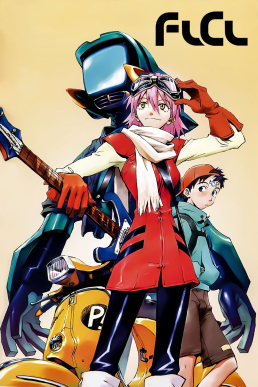
A pink-haired alien on a yellow Vespa runs a twelve-year-old kid over, then revives him and smacks him in the skull with an electric bass. Six episodes later, the FLCL anime has rewired how you think an anime is allowed to look, sound, and move. We love this show to pieces, and if you are only now discovering Fooly Cooly, you picked a perfect moment to start. The FLCL anime crams more ideas into roughly two and a half hours than most series manage across fifty. So let us break the whole thing down, from Naota and Haruko to every single season, so you know exactly what you are watching and why fans still lose their minds over it decades later.
What Is the FLCL Anime?
FLCL, said out loud as “Fooly Cooly,” is a six-episode original video animation that released in Japan from April 2000 to March 2001. It was directed by Kazuya Tsurumaki, who came up working under Hideaki Anno on Neon Genesis Evangelion, with a screenplay by Yoji Enokido. The production was a team-up between Gainax and Production I.G, backed by King Records, which is a huge reason the visuals swing so wildly between styles.
Here is what makes FLCL special. It flat out refuses to sit still. One scene plays like a normal slice-of-life drama, the next turns into a manga panel come to life with speech bubbles and all, and then it snaps into a South Park style cutout gag. Tsurumaki basically treated the whole project like a sandbox and threw every idea he had at the wall. Almost all of it stuck.
American fans mostly found the show through Adult Swim, where the English dub aired and slowly grew into a full cult obsession. For years this was the anime older fans handed to younger ones with a simple pitch: “just trust me, watch it twice.” And you really do need to watch it twice. The first time you feel it. The second time you finally get it.
The Story of Fooly Cooly

At the center of Fooly Cooly is Naota Nandaba, a twelve-year-old living in the dead-boring suburban town of Mabase. A giant iron-shaped factory sits on the edge of town belching steam into the sky, and Naota spends his days acting way more grown up than he actually is. He is the classic kid who thinks being cool means pretending nothing excites him.
That act shatters the second Haruko shows up. She runs him over with her Vespa, revives him with CPR, then cracks him across the skull with her blue electric bass. That hit does something bizarre. It opens what the show calls an “N.O.” channel right in the middle of Naota’s forehead, and giant robots start climbing out of his head. Not a metaphor. Literal robots.
From there Haruko muscles her way into the Nandaba household as a live-in maid, and Naota’s quiet life detonates. Robots keep bursting from his head, a company called Medical Mechanica keeps trying to do something sinister to the town, and Naota gets dragged into a war he barely understands. Under all the noise, it is a coming-of-age story about a kid terrified of growing up and equally terrified of staying the same. The robots erupting from his forehead are puberty, basically. Loud, embarrassing, and impossible to control.
FLCL Haruko: The Alien Who Started It All
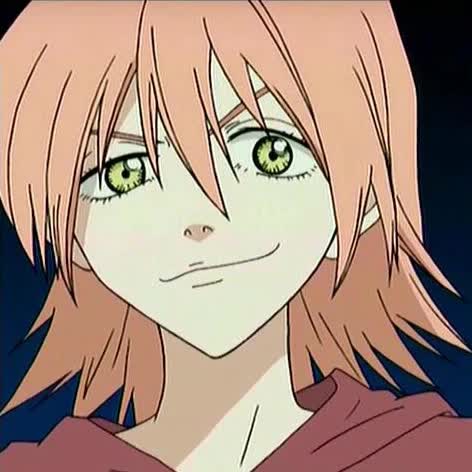
Let us talk about the queen herself, because you cannot cover FLCL Haruko without gushing a little. Haruko Haruhara is a pink-haired alien investigator who rides a Vespa, swings a blue left-handed Rickenbacker 4001 bass as her weapon of choice, and lies constantly with a giant grin on her face. Her bass is not just for hitting people either. It has a chainsaw-style pull cord, it fires like a gun, and it even doubles as a space-warping device. She is chaos in human form, and she is the reason this show has a fandom at all.
For a long time people slapped the “manic pixie dream girl” label on her, but Haruko turns that trope inside out. She is not here to fix a sad boy’s life. She is using Naota to reach her own goals, and she does not really care what it costs him. That selfish streak is what makes her fascinating instead of grating. She has the kind of gremlin energy that would make her a natural streamer if she ever swapped the Vespa for a webcam. If you love that unhinged chaos, you already know it is the same energy that powers a ton of your favorite VTubers.
What is Haruko actually after? Power. Specifically the power of Atomsk, the legendary Pirate King and the strongest being in the galaxy. Every move she makes, every lie she feeds Naota, is in service of chasing that power. She is not a mentor. She is a hurricane that happens to teach Naota something on her way through.
The Cast Around Naota
FLCL is Naota and Haruko’s show, but the supporting cast gives it real emotional weight. Here are the names you need to know.
- Mamimi Samejima. The older girl who used to date Naota’s brother Tasuku before he left for America on a baseball scholarship. Now she clings to Naota as a stand-in and drifts through life feeling abandoned. She is one of the saddest characters in the whole thing.
- Canti. A robot that pops out of Naota’s head early on and then sticks around as a strange TV-headed guardian. Canti becomes weirdly lovable, and he plays a massive role in the finale.
- Kamon Nandaba. Naota’s embarrassing dad, who runs a tiny local newspaper and instantly falls for Haruko. He is comic relief with a few surprisingly sharp edges.
- Eri Ninamori. A classmate and class president with a crush on Naota. She gives the show a grounded, real-kid subplot in the middle of all the sci-fi madness.
Every one of these characters is wrestling with the same core problem in their own way. They are all stuck between who they were and who they are becoming. That is the glue holding the surreal parts together.
Medical Mechanica, Atomsk, and What It All Means
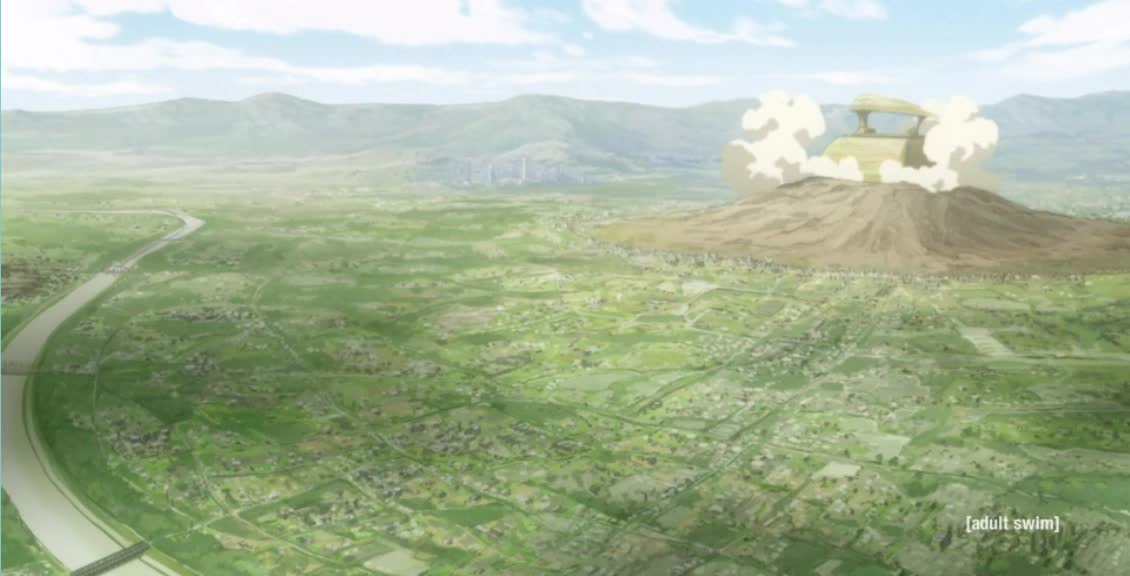
Okay, so what is the plot actually about once you peel away the robots? Two forces are pulling on the town of Mabase. On one side you have Medical Mechanica, that giant iron-shaped factory. Its goal is to “smooth out the wrinkles” of human brains, which is a fancy way of saying it wants to flatten everyone into dull, identical, thought-free conformity. The iron shape is the giveaway. It literally wants to press people flat.
On the other side you have Atomsk, the Pirate King, who represents raw freedom and the messy power of becoming your own person. Haruko is stuck in the middle chasing Atomsk, and Naota gets caught in the crossfire.
Read it as a metaphor and it clicks into place. Growing up is the battle between the pressure to conform and iron yourself out, and the wild, terrifying pull to be fully, uniquely you. Naota’s head is the battlefield. That is why robots keep firing out of it. His mind is the exact spot where childhood and adulthood are fighting for control. Once you see that, every bonkers visual in the show suddenly has a point.
The Pillows and That Legendary Soundtrack
You cannot separate FLCL from its music. The entire soundtrack comes from the Japanese alternative rock band the pillows, and the show would not hit the same without them. Tracks like “Ride on Shooting Star,” “Little Busters,” and “I Think I Can” are stitched into the action so tightly that they basically become another character.
The official music video for the pillows’ “Ride on Shooting Star,” the track welded to that first bass swing:
The staff storyboarded scenes with specific pillows songs already playing in their heads, and it shows. In the very first episode, Naota’s big bass swing lines up perfectly with the explosive chorus of “Ride on Shooting Star.” The animation and the guitar riff move as one thing. That level of sync is why so many people say FLCL feels less like an anime and more like the longest, coolest music video ever made.
If FLCL was your gateway to the pillows, you are in excellent company. The band picked up a whole generation of Western fans purely because of this show, and they still get huge cheers at concerts the second a FLCL track kicks in. Frontman Sawao Yamanaka and company basically got adopted by anime fans overseas, and they have leaned into it, touring the States off the back of that FLCL love.
Every FLCL Season Explained
Now the part everyone asks about, because the FLCL seasons get confusing once you go past the original. Here is the clean rundown in order.

- FLCL (2000). The original six episodes. This is the masterpiece, the one everything else gets measured against. Start here, no exceptions.
- FLCL Progressive (2018). The first sequel, made for Adult Swim. It follows Hidomi Hibajiri, a fourteen-year-old girl who is numb to the world and hides behind her headphones. Haruko returns, but split in ways that get wild.
- FLCL Alternative (2018). Airing right after Progressive, this one follows seventeen-year-old Kana and her friend group as adulthood looms. Kana is the oldest FLCL lead, and she is the one clinging hardest to childhood. Plenty of fans consider Alternative the strongest of the sequels.
- FLCL Grunge (2023). Part of a newer batch ordered by Adult Swim, released in September 2023 with a distinct animated look and a darker tone.
- FLCL Shoegaze (2023). The companion piece to Grunge, animated by studio NUT and directed by Yutaka Uemura, released weeks later in October. It leans into a softer, more melancholy mood that fits its name, and the pillows returned with a fresh ending theme.
Adult Swim’s official trailer for the FLCL Progressive and Alternative sequels:
Notice the pattern? Every sequel is named after a rock genre. Progressive, Alternative, Grunge, Shoegaze. It is a nod back to the pillows and the music-first DNA baked into the whole franchise.
Our honest watch advice: watch the original first and let it breathe. Then pair Progressive and Alternative together, since they were built as two parallel stories. Only chase down Grunge and Shoegaze if you want more. The original stands completely on its own, and plenty of fans happily stop there. That chaotic-gremlin appeal, by the way, is the same reason so many people fall for chaotic streamers like Filian and Nyanners, so if FLCL hooked you, that scene is absolutely worth a look.
Frequently Asked Questions
What does FLCL or Fooly Cooly actually mean?
Not much, and that is kind of the joke. The title is playful nonsense that just sounds cool, though fans love reading cheeky double meanings into it. The creators have leaned into the mystery rather than pin down one official definition, so “Fooly Cooly” mostly means whatever the vibe of the show means to you.
How many episodes is the original FLCL anime?
Just six. The original FLCL anime released from April 2000 to March 2001, and each episode runs around twenty-five minutes. You can knock out the entire original series in a single evening, which is a big reason it is such an easy show to recommend.
Do I need to watch the FLCL seasons in order?
For the best experience, yes. Start with the original FLCL, then move on to Progressive and Alternative, and save Grunge and Shoegaze for last. The sequels reference the original constantly, so watching that first makes everything land way harder.
Is FLCL Haruko a villain?
Not exactly. FLCL Haruko is more of a self-serving wildcard than a straight villain. She lies, manipulates, and uses Naota to chase Atomsk’s power, but she also drags him out of his shell and forces him to grow. She lives in that gray zone between friend and threat, which is exactly why fans adore her.
Where can I watch Fooly Cooly?
Fooly Cooly has floated around Adult Swim and various streaming platforms over the years, and physical Blu-ray sets collect the whole franchise. Availability shifts by region, so a quick check of the big anime streaming services will point you to wherever it is currently living.
Is the FLCL anime good for beginners?
It depends on the beginner. FLCL throws you into the deep end with fast editing and surreal imagery, so it is not the gentlest first anime. But if you like being a little confused and then rewarded for paying attention, it is one of the most exciting rides in the medium. Watch it twice and it becomes a favorite.